
How CBT for Couples Therapy Can Change Unhelpful Relationship Patterns
CBT for couples therapy helps partners spot the thoughts, feelings, and habits that fuel repeat conflicts, then practice better ways to respond. It is a structured, present-focused approach that can help with communication breakdowns, emotional distance, high conflict, infidelity recovery, and stress related to anxiety, depression, or trauma.
In sessions, couples often learn to:
- Notice triggers and assumptions, such as “They do not care about me.”
- Replace blame and mind-reading with clearer, more balanced interpretations.
- Practice skills like active listening, I-statements, problem-solving, and time-outs.
- Use between-session exercises to turn new skills into everyday habits.
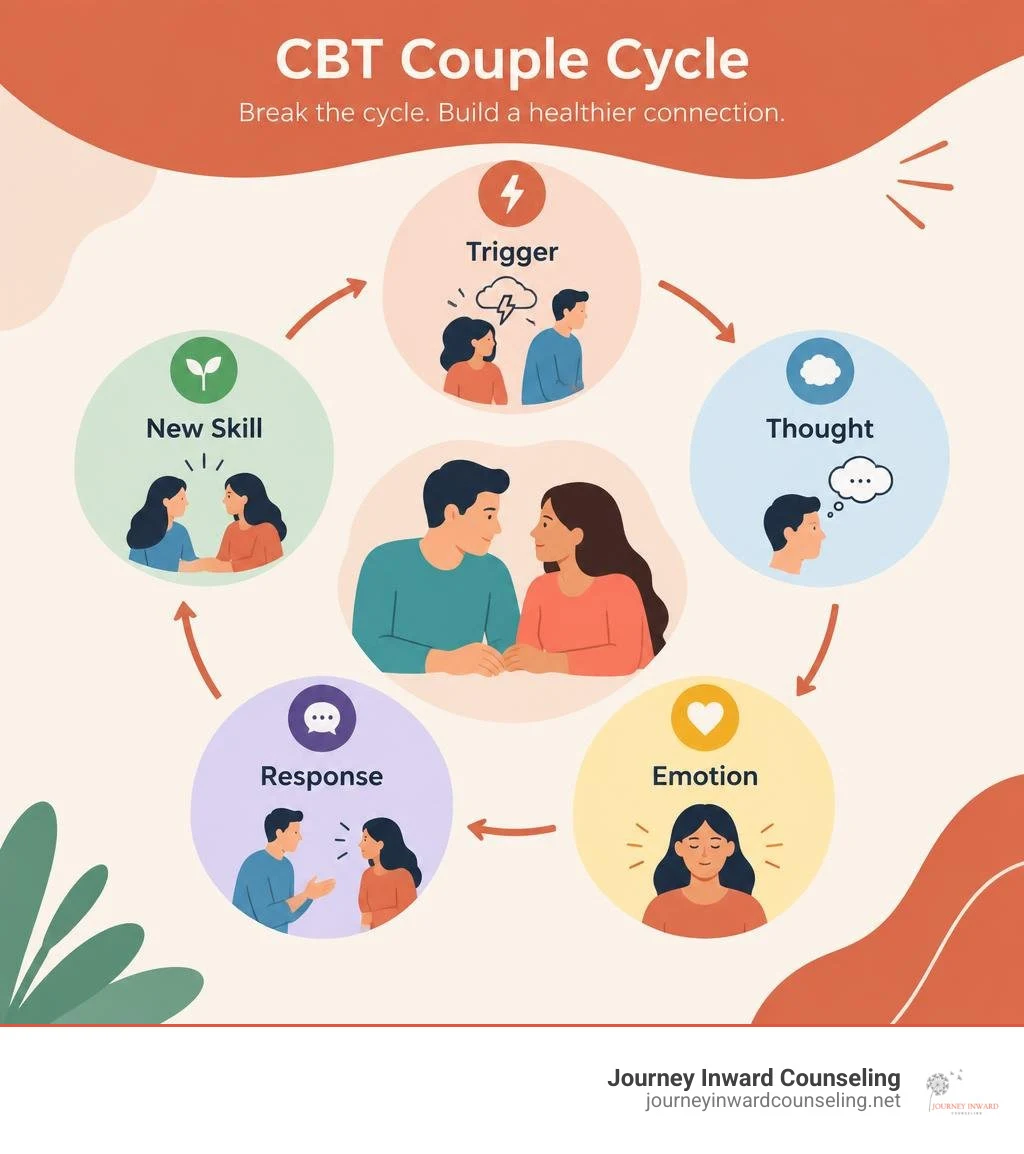
The goal is not to decide who is right. It is to help both partners understand the cycle they get stuck in and work against that cycle together. For example, job stress may make one partner withdraw while the other pushes for reassurance, creating arguments neither person intended.
CBT is especially useful for couples who want practical tools, clear goals, and a way to measure progress while making room for the emotions underneath the conflict.
What Is Cognitive-Behavioral Couples Therapy?
At its heart, Cognitive-Behavioral Couples Therapy (CBCT) applies the proven principles of cognitive psychology and social learning theory to the intimate dance between two people. When individuals struggle alone, their internal dialogue shapes their mood; in a relationship, that internal dialogue shapes how they respond to each other.
Couples often develop automatic relationship schemas—deeply held, often subconscious rulebooks about how a partnership “should” work. When real life inevitably clashes with these expectations, misunderstandings follow. For instance, if one partner assumes that love means constantly checking in, while the other believes love means respecting personal space, an unanswered text message becomes a battlefield rather than a minor logistical oversight.
Through cognitive restructuring, partners learn to examine their dyadic appraisals: the lightning-fast stories they tell themselves about their partner’s motives. Grounded in A COGNITIVE-BEHAVIORAL APPROACH TO RELATIONSHIPS, this collaborative model invites couples to step back, untangle communication knots, and align their day-to-day actions with their shared values.
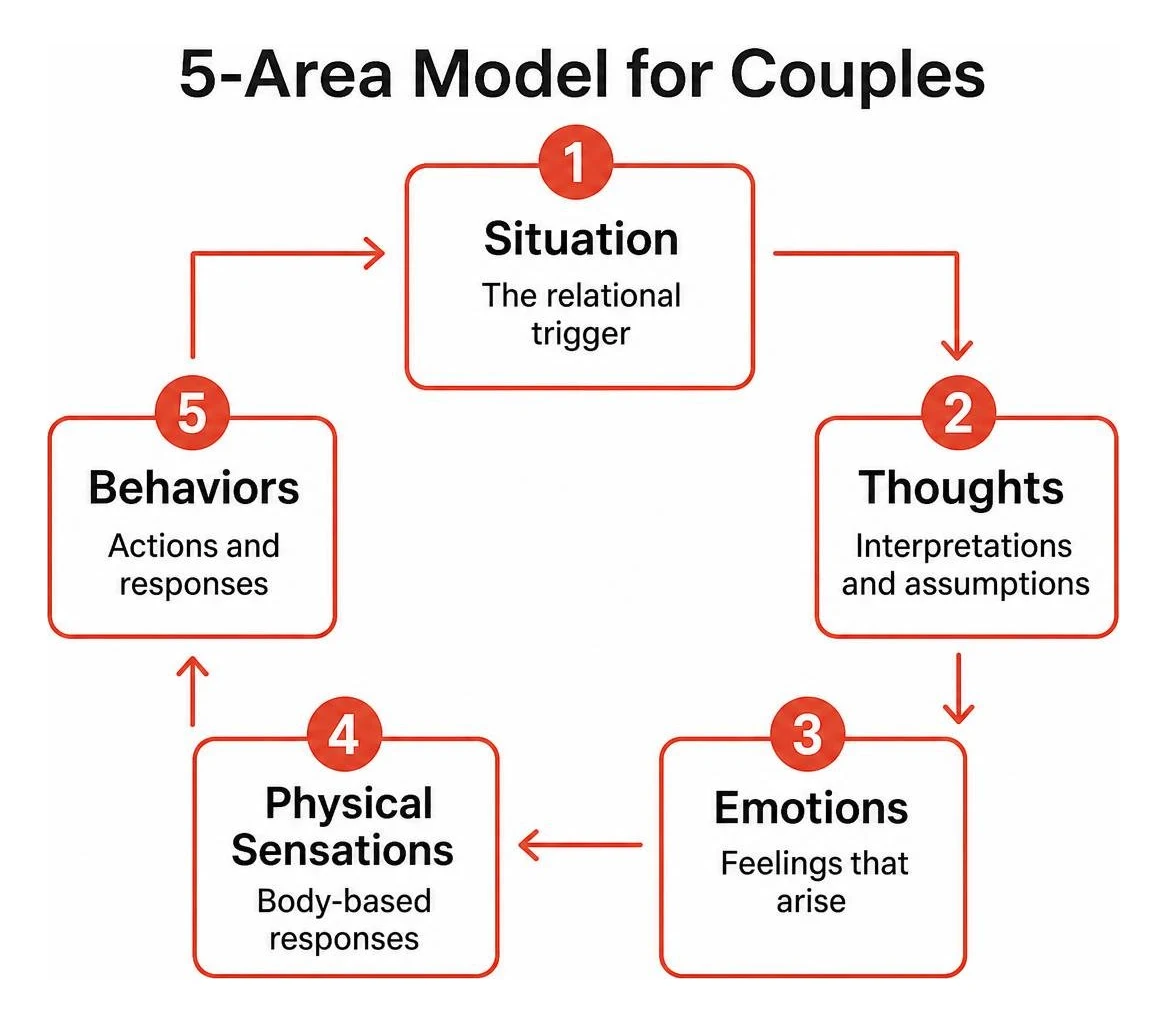
The 5-Area Model in Dyadic Assessment
To understand why a simple dispute about household chores can suddenly erupt into an existential argument, clinicians often use the 5-Area Model. As outlined in Treatment Plans and Interventions in Couple Therapy: A Cognitive-Behav, mapping these five interconnected dimensions helps partners view conflict objectively:
- Situation (The Relational Trigger): An objective event occurs (e.g., one partner arrives home 30 minutes late without calling).
- Automatic Thoughts: Internal interpretations take over (“They have zero respect for my time” or “I am always an afterthought”).
- Emotional Reactivity: Feelings of anger, abandonment, resentment, or anxiety surge.
- Physiological Sensations: The nervous system activates with a racing heart, shallow breathing, clenched jaw, or stomach tension.
- Behavioral Responses: Action follows thought—either stonewalling, aggressive cross-examination, or sarcastic jabs.
When both individuals run through this cycle simultaneously, their behavioral responses become each other’s triggers, creating an escalating loop. Dyadic CBT helps couples catch this sequence before it spins out of control.
Core Techniques in CBT for Couples Therapy
Rather than just talking about problems, sessions focus on teaching repeatable skills. Our clinicians who provide couples, marital, and family therapy lean on several foundational CBT tools:
- Attribution Retraining: Partners naturally assign intent to each other’s behaviors. Attribution retraining shifts blame-centered narratives (“You did that to hurt me”) toward mutual curiosity and realistic appraisals (“You were overwhelmed and distracted”).
- Speaker-Listener Rules: A structured communication protocol where the speaker expresses feelings using concise “I-statements” without blaming, and the listener paraphrases what they heard before offering their own perspective.
- Structured Assertiveness Training: Teaching partners how to ask for their needs directly and kindly rather than hoping the other person will read their mind.
- Time-Out Protocols: Establishing agreed-upon de-escalation breaks when physiological flooding occurs, ensuring that both partners step away to soothe their nervous systems and return to the topic at a set time.
- Behavioral Experiments: Testing negative assumptions in real time (e.g., “If I ask for help with the dishes, they will just yell at me” is tested by making a specific, calm request and recording the actual outcome).

Comparing CBT for Couples Therapy with Other Couples Therapy Approaches
Couples often want to know how cognitive-behavioral couples therapy compares with other evidence-based approaches. Although approaches may differ in their theory and session style, the goal is similar: help partners reduce distress, communicate more effectively, and build a more secure, satisfying relationship (Bodenmann et al., 2020).
| Feature | Cognitive-Behavioral Couples Therapy (CBCT) | Emotion-Focused Couples Work | Skills-Based Relationship Therapy |
|---|---|---|---|
| Core theoretical model | Social learning theory and cognitive science | Attachment, emotion, and relational safety | Behavioral observation, communication, and shared values |
| Primary mechanism | Cognitive restructuring, behavior change, and problem-solving | Exploring vulnerable emotions and strengthening connection | Reducing destructive interaction patterns and practicing constructive habits |
| Role of the therapist | Skill educator, collaborative coach, and Socratic guide | Process facilitator and experiential guide | Relationship coach and skills instructor |
| Session structure | Structured, goal-oriented, with between-session practice | Process-oriented, with guided in-session conversations | Semi-structured, with assessment and practical exercises |
| Primary focus | Present interactions, unhelpful thoughts, and communication habits | Emotional safety, attachment needs, and connection | Friendship, conflict management, and shared meaning |
Therapeutic Mechanisms and Emotional Processing
A common misconception is that CBT focuses on logic while ignoring emotions. Modern cognitive-behavioral work recognizes that emotions are closely tied to the meaning people make of events and interactions (Bodenmann et al., 2020).
Some couples therapies focus primarily on accessing vulnerable emotions and building emotional safety. CBCT uses guided questions and cognitive reframing to help partners examine how assumptions about each other can intensify difficult feelings. By combining emotional awareness with structured communication practice, couples can respond to distress without dismissing the feelings underneath it.
Research Outcomes and Effect Sizes
Cognitive-behavioral couple interventions have an extensive research base. Meta-analyses of behavioral and cognitive-behavioral couple therapies have found meaningful reductions in relationship distress (Fischer et al., 2016). Individual results vary based on the concerns being addressed, each partner’s engagement, and the fit between the treatment plan and the couple’s goals.
Research on cognitive-behavioral couple therapies also supports their use for relationship distress, co-occurring mental-health concerns, and chronic health challenges. A qualified therapist can help a couple decide whether a structured, skills-based approach is the right starting point for their situation.

Clinical Applications: When Is Dyadic CBT Most Effective?
Because of its practical and structured framework, CBT is well-suited for a wide range of relationship dynamics:
- High-Conflict Communication: Couples stuck in frequent, unproductive arguments benefit from structured speaking rules, time-out routines, and de-escalation tools.
- Infidelity and Betrayal Recovery: Rebuilding trust requires concrete steps, accountability plans, and challenging trauma-induced cognitive distortions.
- Co-Parenting Alignment: Parents who clash over disciplinary styles use four-step problem-solving models to create consistent household routines.
- Chronic Health Conditions and External Stress: Couples navigating illness, financial strain, or job transitions learn joint coping strategies that keep external pressure from turning into internal division.
Cognitive-Behavioral Conjoint Therapy for Trauma and PTSD
One of the most notable modern adaptations is Cognitive-Behavioral Conjoint Therapy (CBCT) for PTSD. Trauma does not live in isolation; it deeply affects relationship dynamics. When one partner struggles with PTSD, the other partner often steps in to accommodate their symptoms—such as avoiding crowded places, canceling social events, or tip-toeing around potential triggers. While well-intentioned, partner accommodation can inadvertently maintain avoidance behaviors and worsen isolation.
Studies such as Cognitive-Behavioral Conjoint Therapy for Posttraumatic Stress Disorder: Application to a Couple’s Shared Traumatic Experience demonstrate how involving both partners helps dismantle avoidance cycles and build mutual safety. Real-world implementation research in veterans, including findings from the Effectiveness of cognitive behavioral conjoint therapy for posttraumatic stress disorder (PTSD) in a U.S. Veterans Affairs PTSD clinic, shows that dyadic CBT significantly reduces PTSD symptoms ($d = -0.69$) while improving relationship happiness and reducing partner burden.
Who Benefits Most from CBT for Couples Therapy?
CBT is particularly rewarding for couples who prefer clarity, actionable steps, and tangible homework over unstructured dialogue. It is also an ideal fit when relationship distress coincides with individual mental health struggles, such as major depressive disorder, generalized anxiety, or obsessive-compulsive disorder (Fischer et al., 2016).
When partners are aligned, change happens quickly. However, even if you are navigating therapy when one partner hesitates, the skills learned in relationship therapy can still shift negative cycles. Many clients also find it helpful to pair dyadic work with concurrent individual therapy to focus on personal self-regulation alongside their shared goals.
Navigating the Process: What to Expect in Sessions
Therapy begins with a clear assessment phase so you know exactly where you are headed. If you are preparing for your initial appointment, learning what to expect during the first therapy session can help ease any opening jitters.
A typical CBT course lasts between 12 and 20 sessions and follows a steady rhythm:
- Brief Mood and Agenda Check: Reviewing the past week’s progress, checking in on mood, and setting an agenda for the current hour.
- Homework Review: Discussing insights, challenges, and successes from the between-session exercises.
- Skill Instruction and In-Session Practice: Introducing a new communication or cognitive tool and practicing it through live role-play or guided conversation.
- Actionable Homework Assignment: Collaboratively designing real-world practices for the coming week to cement the skills.
Phase-by-Phase Roadmap for Couples
The therapeutic progression follows five distinct, collaborative steps:
- Pattern Mapping: Identifying the recurring cycles, interactional triggers, and cognitive assumptions that fuel relationship gridlock.
- Trigger Exploration: Unpacking the internal and external stressors—from work exhaustion to attachment histories—that intensify emotional reactions.
- Tolerance and Boundary Calibration: Defining acceptable boundaries, communication limits, and realistic expectations for both partners.
- Behavioral Replacement: Introducing healthy communication tools, assertiveness scripts, and problem-solving exercises to replace old, unhelpful habits.
- Formalized Emotional Contracts: Establishing an explicit, agreed-upon summary of commitments, values, and maintenance plans to safeguard long-term relationship health.
Frequently Asked Questions About Couples Therapy
Finding the right therapeutic path can bring up plenty of practical questions. For broader information about our counseling modalities, browse our comprehensive therapy FAQs.
How does CBT differ from traditional marriage counseling?
Traditional marriage counseling often operates as open-ended talk therapy, where couples bring in the dispute of the week and the therapist serves as a mediator or referee. CBT is fundamentally educational and skill-driven. Sessions focus on identifying cognitive biases, teaching concrete interaction tools, and assigning specific exercises to practice at home.
How long does CBT for couples typically take?
Because CBT is structured and goal-oriented, most couples complete an active course of treatment within 12 to 20 weekly sessions. Once foundational skills are established, sessions may taper to bi-weekly or monthly maintenance check-ins to support long-term relapse prevention.
Can CBT help if only one partner is committed to change?
Yes. While conjoint therapy works fastest when both partners participate, relationships are interconnected systems. When one partner shifts their behavioral patterns—stepping out of blame games, using de-escalation strategies, and setting healthy boundaries—the entire relational dance changes.
Conclusion
Every relationship experiences rough patches, miscommunications, and periods of emotional distance. Relationship distress does not mean a partnership is broken; more often, it simply reveals that the tools you are using no longer match the challenges you face.
CBT provides practical, structured, and evidence-supported tools to transform how you and your partner think, communicate, and connect. By replacing automatic assumptions with curiosity, practicing clear communication, and working toward shared values, you can build a resilient, fulfilling partnership.
At Journey Inward Counseling, our compassionate therapists support couples throughout the Boulder, Colorado area and across the state through secure telehealth. Whether you are addressing communication hurdles, healing from trauma, or simply looking to deepen your connection, we are here to help. To take the next step toward a stronger partnership, explore evidence-based counseling services and schedule your initial consultation today.
References
Bodenmann G, Kessler M, Kuhn R, Hocker L, Randall AK. “Cognitive-Behavioral and Emotion-Focused Couple Therapy: Similarities and Differences..” Clinical psychology in Europe, 2020. PMCID PMC9645475.
Melanie S. Fischer, Donald H. Baucom, Matthew J. Cohen. “Cognitive‐Behavioral Couple Therapies: Review of the Evidence for the Treatment of Relationship Distress, Psychopathology, and Chronic Health Conditions.” Family Process, 2016. DOI 10.1111/famp.12227.