
How EMDR for Couples Can Help Heal Relationship Trauma
EMDR for couples combines Eye Movement Desensitization and Reprocessing therapy with relational counseling to help partners explore unresolved individual trauma and shared relationship injuries. By incorporating bilateral stimulation—such as rhythmic eye movements, tactile taps, or auditory tones—couples can work with distressing memories and triggers that may fuel recurring arguments, emotional withdrawal, and defensive reactions. This integrative approach may help both individuals strengthen emotional regulation, mutual empathy, and a sense of safety in the relationship.
When intimate partners experience chronic friction or emotional distance, the root cause can extend beyond communication skills alone. Unresolved childhood experiences, past relationship betrayals, or traumatic life events can shape emotional and physical responses. During conflict, partners may react not only to the present conversation but also to painful experiences from the past.
Many couples arrive in therapy believing they simply need better communication tools, only to discover that disagreements can activate old wounds in a new context. Recognizing this pattern can be an important first step toward change, which is why some couples explore trauma-informed approaches such as EMDR alongside traditional couples counseling.
Understanding the Foundations of EMDR Therapy
Developed by Dr. Francine Shapiro in the late 1980s, Eye Movement Desensitization and Reprocessing (EMDR) is a structured psychotherapy best known for treating trauma-related symptoms. EMDR uses a phased process to help people revisit distressing memories without becoming stuck in the same level of emotional overwhelm.
EMDR is grounded in the Adaptive Information Processing (AIP) model. This model proposes that the brain naturally works to process experiences and move toward healing. When someone experiences severe stress or trauma, that process can become overwhelmed. Memories may remain connected to the original sights, sounds, physical sensations, and negative beliefs experienced at the time.
Bilateral stimulation (BLS) is one component of EMDR. It may involve guided eye movements, alternating taps, or alternating sounds. Within a trained therapist’s structured protocol, BLS can support the reprocessing of memories that continue to feel emotionally charged. As a memory is processed, a person may be better able to hold it as something that happened in the past rather than something that is still happening now.
While EMDR was originally designed for individual trauma treatment, clinicians have adapted trauma-informed principles for relational work. Couples-focused EMDR expands the lens to include the relationship as a possible source of both injury and healing. Therapists may help each partner identify the memories, beliefs, and body sensations that surface during conflict, then build enough stability for the couple to respond differently in the present. The EMDR International Association’s guidance on couples work describes integrating EMDR thoughtfully within a trauma-informed relational process.
How Individual Trauma Manifests in Couple Dynamics

In a romantic partnership, two distinct nervous systems interact daily. When one or both partners carry unresolved trauma, ordinary relational interactions can be perceived as threats. Consider the following ways trauma can affect romantic relationships:
- Hypervigilance and misinterpretation: A partner with a history of emotional invalidation or abandonment may experience a neutral facial expression or brief pause as rejection or impending conflict.
- Fight, flight, freeze, or fawn responses: When triggered, partners may lose access to the reflective skills they use when calm. One person may become demanding or angry, while the other shuts down, goes silent, or leaves the room.
- The trigger-response loop: One partner’s protective response can activate the other partner’s core vulnerability. For example, persistent questioning may lead to withdrawal, which can then intensify the questioning.
- Negative beliefs about self and relationships: Traumatic experiences can reinforce beliefs such as “I am not safe,” “I will be abandoned,” or “I am not good enough.” These beliefs may shape how a person interprets their partner’s words and behavior.
Over time, these patterns can become so automatic that couples mistake them for personality clashes or incompatibility, when they may be learned survival responses. Research on clinicians who integrate EMDR with Emotionally Focused Therapy describes this combination as a way to address the trauma processes that can sit beneath relationship distress, while also supporting connection and communication in the present. Read the peer-reviewed qualitative study.
Why Traditional Couples Therapy May Fall Short for Trauma
Standard couples counseling approaches, such as communication coaching or cognitive exercises, focus largely on conscious, verbal interaction. These methods can be valuable for problem-solving and conflict management, but they may not be enough when emotional reactivity is driven by trauma-based responses.
When a partner enters a state of fight-or-flight, the nervous system can make logical reasoning and active listening much harder. Asking an overwhelmed person to use “I” statements in the middle of physiological panic may not create the desired result. EMDR-informed couples work can address this gap by helping partners recognize the nervous-system response underneath the conflict and develop greater capacity to pause, regulate, and reconnect.
Traditional couples therapy and EMDR are not necessarily competing approaches. Many therapists integrate elements of both. Communication tools can help a couple navigate everyday disagreements, while trauma processing may help reduce the intensity of the triggers that make those tools difficult to use. Evidence for couples-focused EMDR is still emerging, so it is important not to treat it as a guaranteed solution or a substitute for an individualized clinical assessment. A published study of an EMDR Couple Protocol examined relationship satisfaction, depression, and anxiety outcomes; its findings should be interpreted alongside a therapist’s judgment about the couple’s needs and safety. Review the study record.
What EMDR for Couples Sessions May Look Like
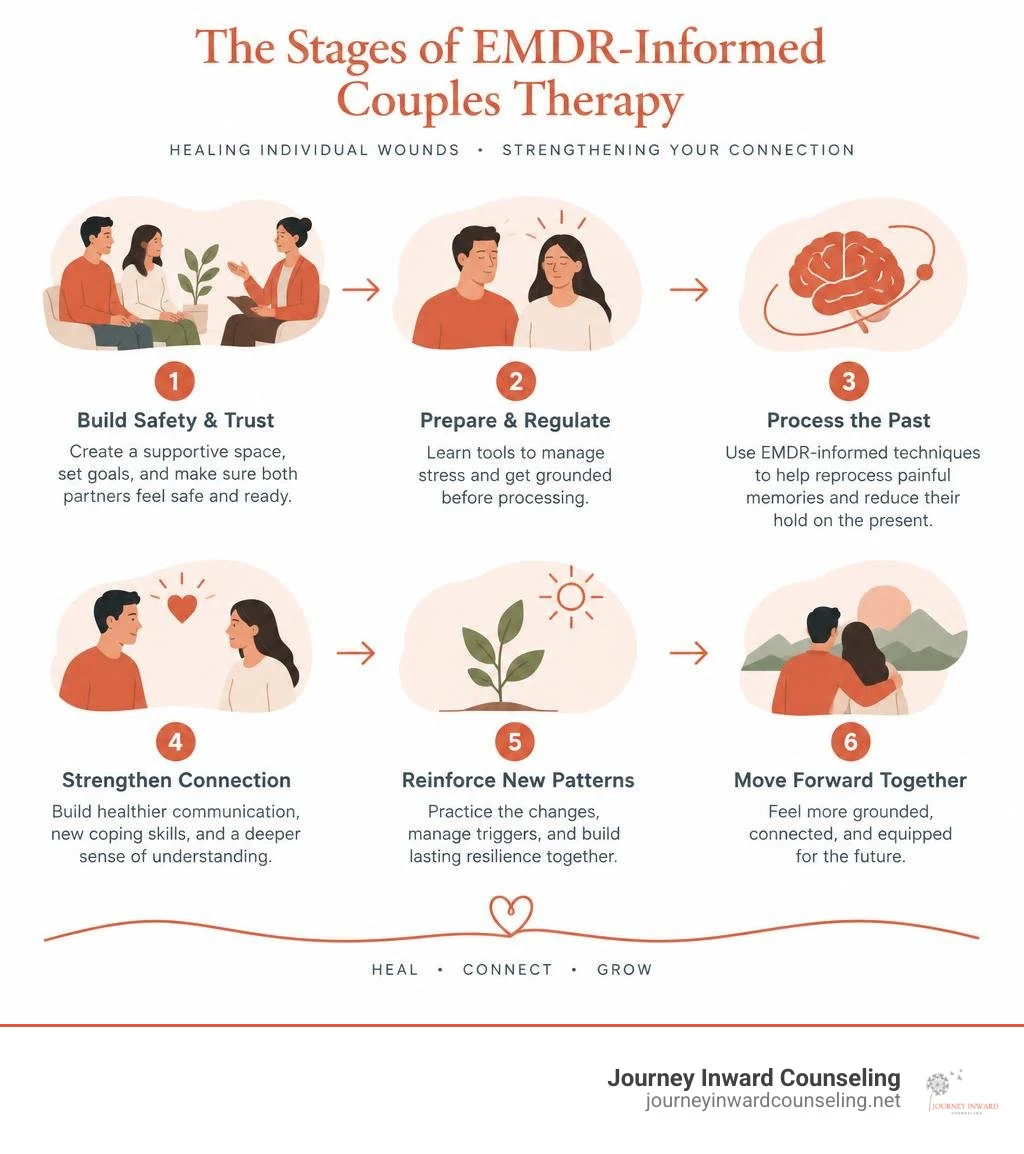
EMDR for couples does not usually mean that both partners immediately process the same painful memory at the same time. A qualified clinician begins with assessment, history-taking, and preparation. They learn about the relationship’s strengths, the couple’s current conflicts, each partner’s trauma history, and the level of emotional and physical safety in the relationship.
Early sessions often focus on stabilization. Partners may practice grounding skills, learn how to recognize escalation, and create agreements for taking breaks during conflict. The therapist may also help the couple identify a recurring cycle—such as one partner pursuing reassurance while the other withdraws—so they can see the cycle as the problem rather than seeing each other as the problem.
When appropriate, the therapist may use EMDR-informed techniques in joint sessions, individual sessions, or a combination of both. One partner might work on a memory that repeatedly affects the relationship, while the other learns how to offer support without becoming overwhelmed. In other situations, a therapist may focus on a shared relational injury, such as betrayal, a frightening medical event, infertility-related grief, or a period of intense conflict.
The pace should be individualized. Effective trauma work prioritizes consent, emotional safety, and the couple’s ability to return to a regulated state after difficult material arises. Partners should feel able to tell the therapist when an exercise feels too intense or when they need to slow down.
Who May Benefit From Couples-Focused EMDR?
Couples may consider EMDR-informed therapy when recurring relationship problems seem connected to trauma, loss, or strong emotional triggers. It may be helpful for partners who want to understand why certain conversations escalate so quickly, why one person shuts down, or why a past injury still feels present despite repeated attempts to move forward.
Examples of concerns that may be explored in therapy include childhood trauma affecting attachment, infidelity-related distress, grief, relationship trauma, difficult transitions, or anxiety and hypervigilance that interfere with intimacy. A therapist can help determine whether EMDR, couples counseling, individual therapy, or a combination of approaches is the best fit.

EMDR for couples is not appropriate for every situation or every stage of a relationship. Active domestic violence, coercive control, ongoing abuse, untreated substance-related instability, or immediate safety concerns may require a different level or type of support before joint trauma work can begin. If anyone is in immediate danger, contact local emergency services or a crisis resource. A trained mental-health professional can assess safety and recommend the appropriate next step.
How to Choose an EMDR Therapist for Couples
Finding the right therapist matters as much as choosing the therapy approach. Look for a licensed mental-health professional who has formal EMDR training and experience working with couples and trauma. Ask whether they use a couples-informed EMDR approach, how they assess readiness, and whether they sometimes recommend individual sessions as part of the treatment plan.
It can also help to ask practical questions before beginning:
- What concerns do you commonly treat with EMDR and couples therapy?
- How do you help partners stay regulated during emotionally intense sessions?
- How do you handle safety concerns or severe conflict between sessions?
- Do you offer in-person, telehealth, or hybrid appointments?
- How will we know whether this approach is helping us?
The best fit is not simply a therapist with the right credentials. Both partners should feel respected, heard, and able to discuss concerns about the process. Therapy works best when it is collaborative rather than rushed.
Evidence and Fact-Checking Notes
This article was reviewed for accuracy on September 28, 2026, against the sources below. They support the discussion of EMDR-informed couples work and the article’s caution that treatment should be tailored to each couple rather than presented as a guaranteed outcome:
- EMDR International Association: Incorporating EMDR Therapy Into Couples Work
- Peer-reviewed study on integrating EMDR and Emotionally Focused Therapy in couple therapy
- Journal of EMDR Practice and Research: EMDR Couple Protocol outcomes
These resources are provided for educational context, not as a diagnosis or a replacement for personalized mental-health care. Research on EMDR used specifically in couples therapy is developing, and a qualified clinician can help determine whether individual EMDR, couples therapy, or another approach is appropriate.
About the Author
This article was written by Journey Inward Counseling, a therapy practice in Boulder, Colorado. The practice is led by Sarah Carlson, MS, LMFT, offering compassionate, trauma-informed, and relational therapy to support individuals and couples navigating life transitions, trauma, and relationship challenges.
A More Compassionate Path Forward
EMDR for couples offers a trauma-informed way to understand the deeper patterns that can keep partners stuck. Rather than treating every argument as a communication failure, it invites couples to consider what each person’s nervous system has learned to protect against and how those protective responses affect connection.
For many couples, healing begins with slowing down the cycle, naming the pain underneath it, and practicing new ways to respond. If you are looking for compassionate, evidence-based support in the Boulder area, Journey Inward Counseling offers therapy options for couples and individuals. A qualified therapist can help you decide whether EMDR-informed care, couples counseling, individual therapy, or a combination is the appropriate next step.