
Why DBT Skills for Couples Are Essential in High-Conflict Relationships
Couples practice DBT skills by first pausing physiological reactivity with distress tolerance tools such as TIPP or STOP, then communicating needs and boundaries with DEAR MAN and FAST, and finally using structured validation to reduce defensiveness and rebuild connection. These concrete behaviors are especially important when arguments turn explosive or dissolve into icy silence, because standard communication advice—like “use ‘I’ statements” or “take three deep breaths”—often falls flat. When emotional intensity hits a ten out of ten, the rational prefrontal cortex goes offline, leaving both partners operating purely out of self-preservation.
This dynamic is best understood through the biosocial theory, a cornerstone of Dialectical Behavior Therapy (DBT) developed by Dr. Marsha Linehan. Originally created to treat Borderline Personality Disorder (BPD)—a condition characterized by profound emotional sensitivity and intense interpersonal instability—the biosocial framework explains how biological vulnerability interacts with an invalidating environment. In a relationship, high emotional sensitivity combined with perceived invalidation triggers an overwhelming threat response.
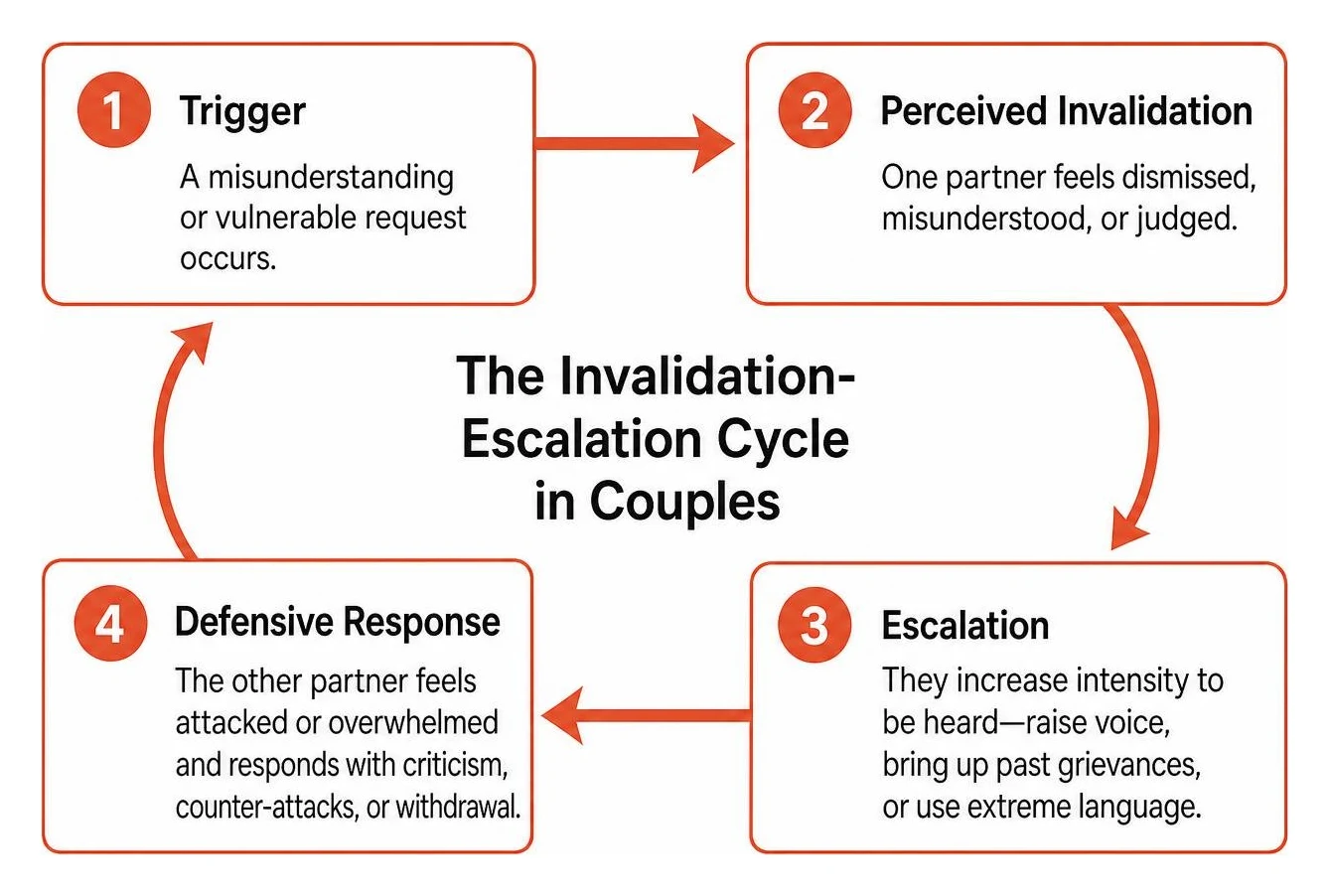
When one partner feels dismissed, misunderstood, or judged, they naturally increase the intensity of their communication to be heard. They might raise their voice, bring up past grievances, or use extreme language. The other partner, feeling attacked or overwhelmed, responds with defensive criticism, counter-attacks, or withdrawal.
This mutual emotional reactivity sets off the invalidation-escalation cycle:
- Trigger: A misunderstanding or vulnerable request occurs.
- Perceived Invalidation: One partner feels dismissed or unheard.
- Intensification: That partner amps up the volume, tone, or urgency.
- Overwhelm & Defense: The receiving partner experiences cognitive and emotional overload, reacting with contempt, stonewalling, or counter-accusations.
- Mutual Escalation: Both individuals feel threatened, and the conversation collapses into a battle for emotional survival.
Research by Dr. Alan Fruzzetti, a leading pioneer in adapting DBT for couples and families, demonstrates that invalidation is the single strongest predictor of relationship distress, while increasing validation between partners reduces conflict more effectively than almost any other therapeutic intervention. Furthermore, a 2023 study published via the National Library of Medicine found that interpersonal effectiveness skills training measurably improved participants’ communication skills. By giving couples structured, concrete behaviors to lean on during high-stress moments, DBT breaks this destructive loop before it starts.
Core Dialectical Behavior Therapy Frameworks for Relationship Distress
The word “dialectical” refers to the integration of opposites. In relationship dynamics, dialectical thinking means moving away from rigid, black-and-white perspectives (“I am right, and you are wrong”) and learning to hold two seemingly contradictory truths at the exact same time.
The central dialectic in couples work balances acceptance and change:
- I accept you exactly as you are right now, with all your flaws and emotional triggers.
- AND I need you to change specific behaviors so our partnership can stay healthy and safe.
Similarly, it requires embracing the foundational DBT assumption: “You are doing the best you can with the skills you currently have, AND you need to do better, try harder, and learn new behaviors to improve the relationship.”
When couples shift from an “either/or” mindset to an “and” mindset, defensiveness drops. You no longer have to prove who is at fault. Instead, you can look at the dynamic between you as a shared problem requiring shared tools. Learning to balance assertiveness and connection illustrates how holding space for both partners’ needs transforms everyday conversations.
Essential DBT Skills for Couples: The Interpersonal Effectiveness Triad
In DBT, interpersonal effectiveness is built upon three foundational acronyms that balance objective goals, relationship health, and personal integrity.
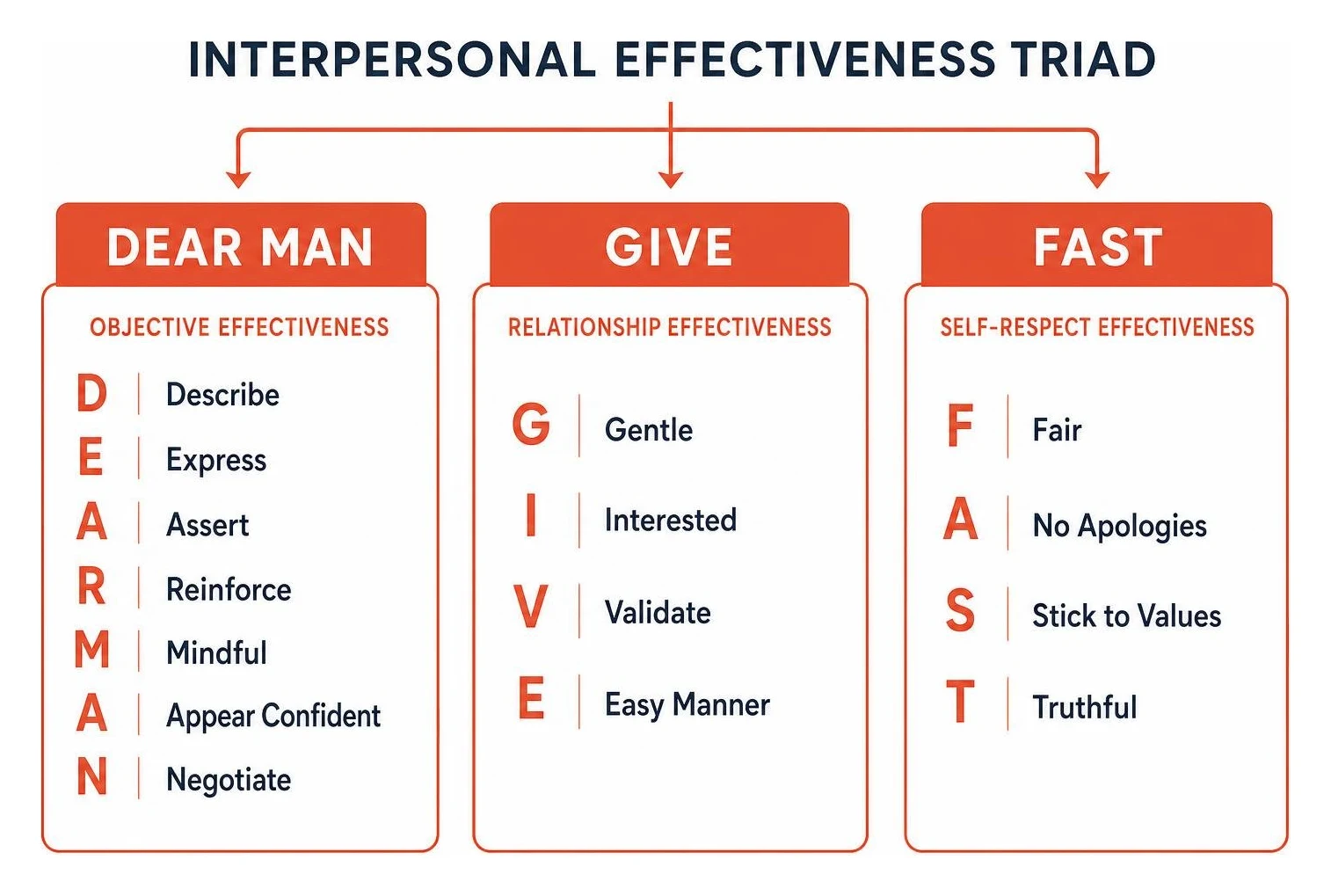
1. DEAR MAN (Objective Effectiveness)
Use DEAR MAN when you need to ask for something specific, say no to an unreasonable demand, or set a clear boundary without derailing the conversation.
- D – Describe: Stick purely to the objective facts without judgment or drama. (Instead of: “You always leave a mess,” try: “There are dishes in the sink from lunch.”)
- E – Express: State your feelings using “I” statements. (“I feel overwhelmed when I come home to clean after work.”)
- A – Assert: Ask clearly and directly for what you want or do not want. Do not expect mind-reading. (“Could you please wash the dishes before dinner?”)
- R – Reinforce: Explain the positive outcome for both of you if the request is met. (“It will help me relax so we can enjoy our evening together.”)
- M – (Stay) Mindful: Keep your focus on the core topic. Ignore side-trackers, bait, or counter-complaints by acting as a “broken record.”
- A – Appear Confident: Maintain steady eye contact, an even tone, and open body language.
- N – Negotiate: Offer alternative solutions and be willing to give to get. (“If you don’t have time to do all of them, could you clear the counter and run the dishwasher?”)
2. GIVE (Relationship Effectiveness)
Use GIVE to keep your partner feeling safe, respected, and connected, especially during disagreements.
- G – Gentle: Avoid attacks, threats, sneering, eye-rolling, or sarcasm.
- I – Interested: Actively listen without interrupting. Lean in, maintain open posture, and ask curious questions.
- V – Validate: Acknowledge your partner’s emotions, perspective, and internal logic, even if you disagree with their conclusion.
- E – Easy Manner: Use light humor where appropriate, soften your facial expressions, and cultivate an approachable warmth.
3. FAST (Self-Respect Effectiveness)
Use FAST to maintain your personal dignity and values, avoiding the trap of people-pleasing or capitulating just to keep the peace.
- F – Fair: Be fair to yourself and to your partner. Acknowledge both sides.
- A – (No) Apologies: Do not apologize for having feelings, making reasonable requests, having a boundary, or taking up space.
- S – Stick to Values: Refuse to compromise your core integrity, safety, or personal morals just to end an argument quickly.
- T – Truthful: Do not lie, exaggerate, act helpless, or use passive-aggressive remarks.
When you blend these skills together, you achieve true dialectical communication: you advocate for your needs (DEAR MAN) while preserving warmth and connection (GIVE), all while keeping your self-respect intact (FAST).
The Six Levels of Validation and Emotion Regulation
Validation is not the same as agreeing with someone’s version of the facts. Validation means communicating that your partner’s internal emotional experience makes sense given their history, perceptions, or present situation.
Dr. Marsha Linehan outlined the Six Levels of Validation, moving from basic attentiveness to deep, transformative understanding:
- Level 1: Being Present (Active Listening): Putting down your phone, turning toward your partner, and offering full, undistracted attention.
- Level 2: Accurate Reflection: Paraphrasing their words back to them without interpretation. (“What I’m hearing is that you felt left out during the family gathering.”)
- Level 3: Mind-Reading (Attuned Guessing): Gently checking in on unexpressed feelings based on non-verbal cues. (“I notice your shoulders are tense; are you feeling anxious about tomorrow’s budget talk?”)
- Level 4: Historical Context: Validating based on their past experiences or trauma. (“Given how chaotic your childhood home was, it makes total sense why unexpected changes in plans feel so distressing to you.”)
- Level 5: Present Context / Normal Functioning: Validating that anyone in their current shoes would feel similarly. (“Of course you’re exhausted and cranky; you’ve worked twelve hours straight without a break.”)
- Level 6: Radical Genuineness: Meeting your partner as an equal human being with deep empathy, authenticity, and profound vulnerability.
Alongside validation, practicing DBT Emotion Regulation prevents emotional hijackings:
- Checking the Facts: Separate objective reality from cognitive interpretations. Ask yourself: What is the raw data here, and what story am I telling myself about my partner’s motives?
- Opposite Action: When an unhelpful emotion urge arises (e.g., the urge to slam a door or withdraw into cold silence), consciously enact the opposite physical behavior (e.g., lower your voice, unclench your fists, or gently reach out a hand).
Distress Tolerance Tools for De-Escalating Crisis Moments
When arguments cross the physiological threshold into fight-or-flight territory (typically when heart rates exceed 100 beats per minute), productive communication becomes biologically impossible. Distress tolerance tools help couples safely manage the acute storm.
TIPP Protocol for Physiological De-escalation:
- T – Temperature: Splash cold water on your face or hold an ice cube to activate the mammalian dive reflex and drop your heart rate rapidly.
- I – Intense Exercise: Do a 60-second burst of jumping jacks or a brisk walk to burn off acute adrenaline.
- P – Paced Breathing: Inhale for 4 seconds, hold for 2, and exhale slowly for 7 seconds.
- P – Paired Muscle Relaxation: Systematically tense muscle groups on an inhale and release them completely on an exhale.
Radical Acceptance: Acknowledging reality as it is without fighting it or demanding it be different in this exact second. For couples, this means radically accepting that you have different emotional processing speeds. One partner might need 30 minutes of quiet solitude to self-regulate, while the other craves immediate discussion to calm anxiety.
To manage this mismatch, implement Time-Bounded Structured Breaks: Agree ahead of time that either partner can call a pause using STOP or TIPP, with a concrete, non-negotiable commitment to return to the conversation within a specific window (e.g., 30 minutes to 24 hours).
Real-World Scenarios and Practical Exercises
Step-by-Step Practice: Implementing DBT Skills for Couples in Real-Life Scenarios
To make these concepts concrete, let us look at three common relationship friction points and how DBT tools transform them.
Scenario 1: The Household Labor Imbalance
- The Old Pattern: One partner fumes silently while picking up laundry, finally exploding with: “I do literally everything in this house, and you don’t care at all!” The other partner gets defensive: “I work 50 hours a week! Stop nagging me!”
- The DBT Script (DEAR MAN + GIVE):
- Describe: “I noticed that the laundry and dishes from the weekend haven’t been put away yet.”
- Express: “I feel overwhelmed and drained trying to manage household tasks alone after work.”
- Assert: “I would like us to spend 20 minutes tonight dividing up these chores so we can tackle them together.”
- Reinforce: “If we get this sorted out, we can sit down and watch our favorite show guilt-free.”
- GIVE Integration: Delivered in a gentle, even tone without eye-rolling, validating their fatigue (“I know you had a long day too”).
Scenario 2: Stopping Financial Defensiveness in Real Time
- The Old Pattern: A credit card bill arrives. Partner A says, “Why did you spend $200 on dinners out this week?” Partner B feels a wave of shame, reacts with rage: “Why are you monitoring my every move? You bought new golf clubs last month!”
- The DBT Script (STOP + Checking the Facts + FAST):
- Partner B feels their chest tighten (physical cue).
- STOP: Partner B pauses, takes a breath, and resists the urge to bring up the golf clubs.
- Check the Facts: Is my partner controlling me, or are they pointing out an objective monthly budget discrepancy?
- FAST Response: “You’re right, that spending was higher than we budgeted for (Truthful/Fair). I felt defensive when you brought it up, but let’s look at the numbers together calmly (No unnecessary over-apologizing or counter-attacking).”
Scenario 3: Managing Mismatched Emotional Processing Styles
- The Old Pattern: After an argument, Partner A follows Partner B from room to room demanding a resolution, while Partner B retreats, locks the door, and shuts down completely.
- The DBT Protocol (Radical Acceptance + Structured Timeouts):
- Partner B recognizes flooding and says: “I love you, and I want to resolve this, but my nervous system is flooded right now. I need to practice a 30-minute STOP break. I will be back in the living room at 7:30 PM so we can talk.”
- Partner A uses Radical Acceptance: accepting that pushing for an immediate answer will only trigger stonewalling, using TIPP skills (paced breathing) to manage the distress of waiting.
Essential Ground Rules for Practicing DBT Communication at Home
- No kitchen-sinking: Keep conversations strictly focused on one topic at a time.
- Honor the time-out: If a partner calls a STOP pause, the other must respect the physical boundary, provided a return time is set.
- Separate validation from agreement: Never say “I understand your feeling, but…” (the word “but” erases the validation). Replace it with “and.”
A 15-Minute Daily Couples Practice Routine
You do not have to wait for an emotional earthquake to build these muscles. Set aside 10 to 15 minutes a day during a calm moment to run through this structured connection check-in:
Step 1: The Three-Question Dialectical Self-Check (2 minutes)
Each partner privately asks themselves:- What does my partner need from me right now? (GIVE)
- What do I need for myself in this moment? (DEAR MAN)
- How can I show up in a way that protects my self-respect? (FAST)
Step 2: Micro-Validation Exchange (5 minutes)
Take turns sharing one emotional state or experience from your day. The listening partner provides Level 2 or Level 5 validation without giving advice or trying to fix the problem.Step 3: Low-Stakes Behavioral Rehearsal (8 minutes)
Practice making small requests using DEAR MAN (e.g., weekend schedule preferences or meal planning). Alternate roles so both partners practice clear asserting and gentle listening.
Comparing Relationship Modalities: DBT-Informed Therapy and Other Approaches
Choosing Between DBT and Other Relationship Therapy Approaches
Couples seeking support often wonder how DBT-informed work differs from other traditional relationship therapy frameworks. Understanding how these approaches compare helps partners choose the right fit for their relational dynamics and emotional needs.
| Feature / Dimension | DBT-Informed Couples Therapy | Attachment-Focused Approaches | Structured Communication-Based Approaches |
|---|---|---|---|
| Primary Theoretical Foundation | Biosocial Theory, Behavioral Psychology, Dialectics | Adult Attachment Theory, Humanistic Psychology | Empirical Relational Research, Behavioral Systems |
| Core Target Mechanism | Severe Emotion Dysregulation, High Reactivity, Crisis De-escalation | Unmet Attachment Needs, Vulnerable Emotional Bonding | Relational Friendship, Conflict Management, Shared Meaning |
| Primary Method | Structured behavioral skill acquisition (DEAR MAN, TIPP, STOP) | Experiential tracking and reshaping of emotional cycles | Assessment-driven interventions, structured relational tools |
| Typical Treatment Duration | 16 to 24 sessions | 8 to 20 sessions | 12 to 30+ sessions |
| Best Suited For | High-conflict couples, BPD traits, intense volatility, frequent escalation | Couples stuck in pursue-withdraw loops wanting deeper intimacy | Couples needing structured communication and marital repair |
When to Choose DBT Over Other Approaches
While other relationship therapy approaches can be highly effective, they often rely on partners having a baseline ability to tolerate emotional vulnerability without exploding or shutting down. If conversations instantly turn volatile, or if one or both partners struggle with chronic emotional instability, DBT provides the concrete behavioral stabilization required before deeper experiential or attachment work can take root.
What to Expect in DBT Couples Therapy Sessions and Structure
DBT-informed couples therapy is highly active, structured, and focused on the present moment. Rather than letting partners spend 50 minutes rehashing old arguments on the couch, the therapist acts as an in-session coach.
- Treatment Timeline: Most DBT-informed couples programs span 16 to 24 sessions.
- In-Session Behavioral Coaching: When an argument begins to heat up in the room, the therapist will actively interrupt the interaction. They will pause the conversation, help partners identify their physiological arousal, and coach them through real-time application of STOP, validation, or DEAR MAN frameworks.
- Between-Session Homework: Couples are given specific behavioral diary cards or practice worksheets to track skill usage during real-world conflicts between appointments.
Questions to Ask When Vetting a DBT Couples Therapist
- “Have you completed formal training in Dialectical Behavior Therapy for couples and families?”
- “How do you structure your sessions when arguments become acutely escalated in the room?”
- “Do you focus on active behavioral coaching and skills practice, or is your approach primarily unstructured and talk-based?”
Frequently Asked Questions About DBT for Couples
Can DBT skills help our relationship if neither partner has a BPD diagnosis?
Yes, absolutely. While DBT was originally created for Borderline Personality Disorder, its skills are universal human technologies for emotional regulation and communication. Any couple that experiences high emotional intensity, chronic misunderstandings, defensiveness, or communication fatigue will benefit immensely from learning how to pause, regulate physiology, and communicate with objective clarity.
What if only one partner is willing to practice DBT skills?
Relationships are dynamic systems: when one person changes how they respond, the entire interactive dance shifts. If your partner is currently unwilling to attend therapy, you can learn and implement DBT skills independently through individual therapy. By utilizing FAST to set healthy boundaries, GIVE to validate your partner, and STOP to refuse participation in explosive arguments, you unilaterally disrupt the invalidation-escalation cycle.
How long does DBT-informed couples therapy typically last?
A standard course of DBT-informed couples therapy typically runs between 16 and 24 weeks. The initial phase focuses on crisis stabilization and establishing physical/emotional safety. The middle phase emphasizes deep skill acquisition (interpersonal effectiveness, validation levels, emotion regulation), while the final phase solidifies long-term maintenance and dialectical acceptance.
Conclusion
Healthy, resilient relationships are not defined by the total absence of conflict; they are defined by the speed and skill with which partners de-escalate, validate, and repair. Dialectical Behavior Therapy offers couples a practical, compassionate roadmap away from destructive cycles of reactivity and into an environment of mutual respect, emotional stability, and lasting safety.
If you and your partner are ready to stop the cycle of exhaustion and build actionable relational skills, our team is here to support you. At Journey Inward Counseling, we provide compassionate, evidence-based mental health care tailored to your unique relational needs. Explore our evidence-based couples therapy services to learn how our experienced therapists can help you cultivate a calmer, more deeply connected partnership.