
Written by the Journey Inward Counseling team.
Someone has probably told you by now that you seem to be doing well. Someone else has probably implied, gently or not, that you should be further along. Both of them are guessing.
The question of when to see a therapist for grief does not have a date attached to it. It has a small number of honest markers, and none of them is how many months it has been.
Table of Contents
- There Is No Schedule, and the Stages Were Never One
- What Grief Commonly Looks Like, Including the Parts Nobody Warns You About
- When to See a Therapist for Grief
- Grief That Is Not About a Death
- When Support Is Not a Therapist
- What Grief Work in Therapy Actually Involves
- If You Want to Talk to Someone
- Frequently Asked Questions
There Is No Schedule, and the Stages Were Never One
The five stages most people can recite came from work with people facing their own terminal illness, and the author who described them did not intend them as a sequence that grieving people pass through in order. They got turned into a schedule later, by everyone except her.
What actually happens is less tidy. Grief tends to come in waves rather than phases. It recedes and returns, and it is frequently set off by things that make no obvious sense: a supermarket aisle, a particular kind of weather, someone else’s ordinary good news. Anniversaries are hard, and so are random Tuesdays.
So if you have been measuring yourself against a timeline and coming up short, the timeline is the part that is wrong.
What Grief Commonly Looks Like, Including the Parts Nobody Warns You About
Sadness is the part people expect. The rest often catches them off guard.
Grief frequently shows up as exhaustion, difficulty concentrating, and a memory that has stopped working properly. It shows up as irritability, and as anger at the person who died, which then produces guilt about the anger. It shows up physically, in changes to sleep and appetite. Sometimes it shows up as relief, particularly after a long illness, and relief is one of the hardest parts to admit to anyone.
It also shows up as numbness. Plenty of people worry that they are not grieving properly because they do not feel much at all. That is a common response, not evidence of anything about how much you cared.
If you are in crisis or having thoughts of suicide, call or text 988 to reach the Suicide & Crisis Lifeline, available 24/7. If you are in immediate danger, call 911.
If you would rather talk to someone who does this work, you can read about individual therapy for adults at Journey Inward Counseling, or contact the practice to ask what is available.
When to See a Therapist for Grief
Most grief does not need treatment. People get through it with the people around them, and that is the ordinary case rather than a lucky one.
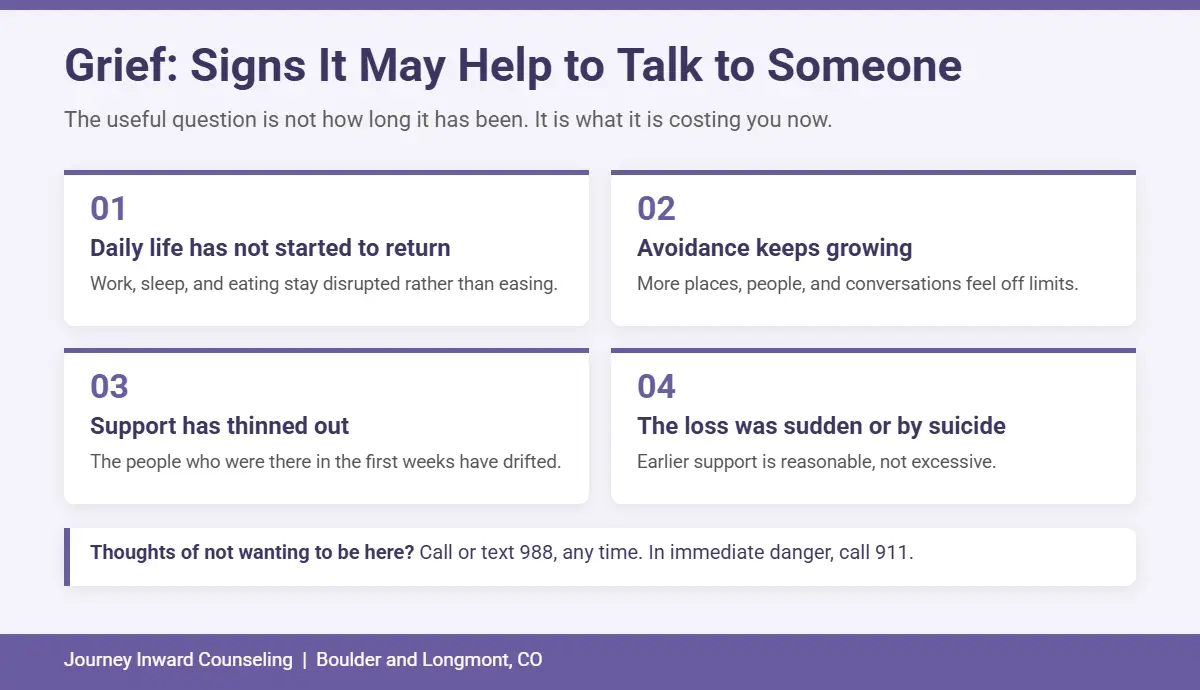
The useful question is not how long it has been. It is what it is costing you now. A few markers are worth paying attention to:
- Daily functioning has not started to return. Work, sleep, eating, and looking after yourself or other people have stayed disrupted over a long stretch rather than gradually becoming more manageable.
- You are avoiding a great deal in order not to feel it. Whole places, people, conversations, or objects have become off limits, and the list is getting longer rather than shorter.
- The people who were supporting you have drifted, or were never there. Grief is hard to carry alone, and support thinning out after the first few weeks is extremely common.
- The loss was sudden, violent, or one you witnessed. These losses are harder for most people, and earlier support is reasonable rather than excessive.
- You lost someone to suicide. This is its own experience, with its own particular weight, and it is one of the situations where talking to someone who works with it is worth doing sooner.
- You are having thoughts of not wanting to be here. That one does not wait for an appointment. Call or text 988 today.
Reaching out does not mean your grief has gone wrong. It means you would rather not do this part without help, which is an ordinary reason.
You can browse the practice’s therapists, then ask the office whether a clinician who works with grief and loss is currently taking new clients.
Grief That Is Not About a Death
Grief attaches to losses that nobody sends cards for.
The end of a marriage. A diagnosis that changed what your life was going to look like. Infertility. A child leaving, or a child who is still here but unreachable. Losing a job you built an identity around. Moving away from somewhere you belonged. Watching a parent become someone who does not know you.
These losses are often harder to grieve, not easier, precisely because there is no ritual and no visible permission. If your experience does not look like bereavement but feels like it, that is a real thing, and it is worth naming as loss rather than as a failure to cope.
When Support Is Not a Therapist
There are situations where something other than therapy fits better, and it is worth saying so.
A grief support group, particularly one for your specific kind of loss, offers something individual therapy cannot: other people who already understand, without you having to explain. Many communities have them, and hospice organizations often run groups that are open to the wider community, not only to the families they served.
If the physical side is dominant, such as persistent exhaustion or a body that will not settle, a check with your doctor is sensible, because grief and medical conditions can look alike. If medication comes up, that conversation belongs with a physician or psychiatrist, and it sits alongside talking rather than instead of it.
And sometimes what is needed is time, plus one or two people who will keep turning up. That is not a lesser answer.
The National Institute of Mental Health has a plain overview of common responses after a distressing event, and the Colorado Behavioral Health Administration lists crisis and walk-in support across the state.
What Grief Work in Therapy Actually Involves
It is not being talked out of missing someone, and no reasonable clinician is aiming to get you back to who you were before.
In practice it is often quite plain. You get to talk about the person, at length, to someone who will not change the subject and does not need protecting from it. You get somewhere to put the parts you cannot say to family: the anger, the relief, the things left unsaid. You work on the practical wreckage, which is frequently enormous and rarely discussed. Where avoidance has narrowed your life, you work on that gradually.
Some clinicians use specific terms for grief that stays severe and disabling over a long period. Those terms describe an assessment that a clinician makes with you, in person. They are not something to apply to yourself from a web page, and this article is not offering you one.
How long any of this takes varies a great deal from person to person, and nobody can tell you in advance where you will land.
If the loss has reshaped how a whole household functions, therapy that involves the family is sometimes a better fit than individual work.

If You Want to Talk to Someone
There is no threshold you have to meet first, and no version of this where you have waited too long or come too early.
Journey Inward Counseling sees clients in Boulder and Longmont. You can contact the practice to ask what is available, or read what to expect in your first therapy session if the unfamiliarity is the part putting you off.
Frequently Asked Questions
How long does grief last?
There is no standard length, and the stage model most people know was never meant as a schedule. Grief tends to come in waves that recede and return rather than progressing in order. A more useful question than how long it has been is what it is costing you day to day, because that is something you can actually answer.
When should I see a therapist for grief?
Consider it when daily functioning has stayed disrupted rather than gradually easing, when avoidance is narrowing your life, when your support has thinned out, or when the loss was sudden, violent, witnessed, or a death by suicide. You do not need to meet a threshold to be allowed to ask for help.
Is what I am feeling normal grief?
Grief includes far more than sadness: exhaustion, poor concentration, irritability, anger at the person who died, guilt about that anger, physical changes, relief, and numbness. Worrying that you are not grieving properly is itself extremely common. A blog post cannot assess you, and nothing here is a diagnosis.
Can you grieve something that is not a death?
Yes. Divorce, a diagnosis, infertility, estrangement, job loss, moving away from somewhere you belonged, and watching a parent’s memory fade are all losses. They can be harder to grieve because there is no ritual and no obvious permission, not because they matter less.
What if I need help right now?
You do not have to wait for an appointment. Call or text 988 to reach the Suicide & Crisis Lifeline, available 24/7. If you are in immediate danger, call 911.
Disclaimer: This article is for general education and is not a substitute for therapy, medical advice, or an individualized clinical assessment. If you are in crisis, call or text 988, or call 911 if you are in immediate danger.